





Article
Does a Medical Aesthetic Clinic Need a Dermatoscope?
Medical aesthetic clinics work directly with the skin every day. During a consultation for laser treatment, hair removal, pigmentation management or another cosmetic procedure, a client may suddenly point to a mole or dark spot and ask whether it is normal, whether it has changed, or whether it could indicate a more serious skin problem….
Medical aesthetic clinics work directly with the skin every day. During a consultation for laser treatment, hair removal, pigmentation management or another cosmetic procedure, a client may suddenly point to a mole or dark spot and ask whether it is normal, whether it has changed, or whether it could indicate a more serious skin problem.
A dermatoscope gives trained professionals a closer view than unaided visual inspection alone. In a medical aesthetic setting, its role is not to provide an independent skin-cancer diagnosis. Instead, it can support closer observation of pigmented lesions, image documentation before treatment and a more structured decision about whether a client should first be referred to a dermatologist.
At IBOOLO, we see dermoscopy as a practical extension of the pre-treatment consultation. A clinic can observe an area more carefully, record a baseline image and avoid treating an uncertain lesion until appropriate medical assessment has been completed.
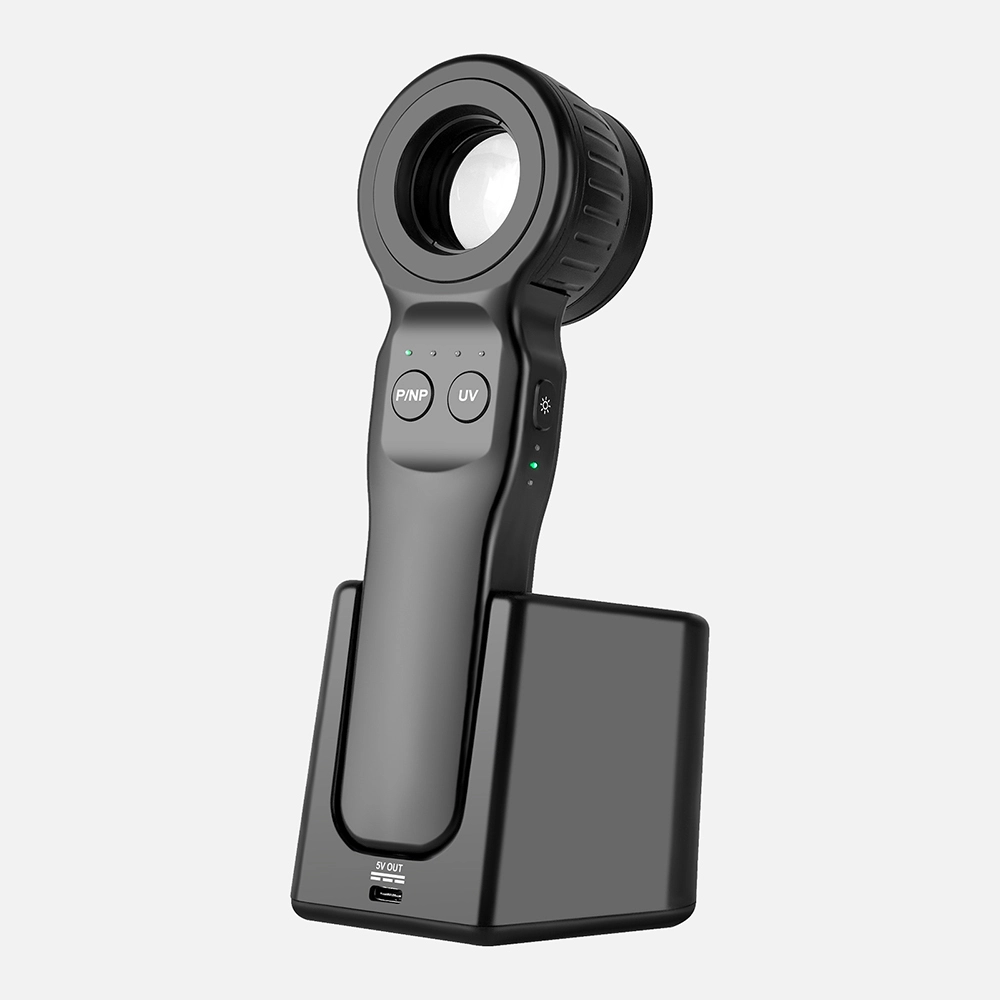
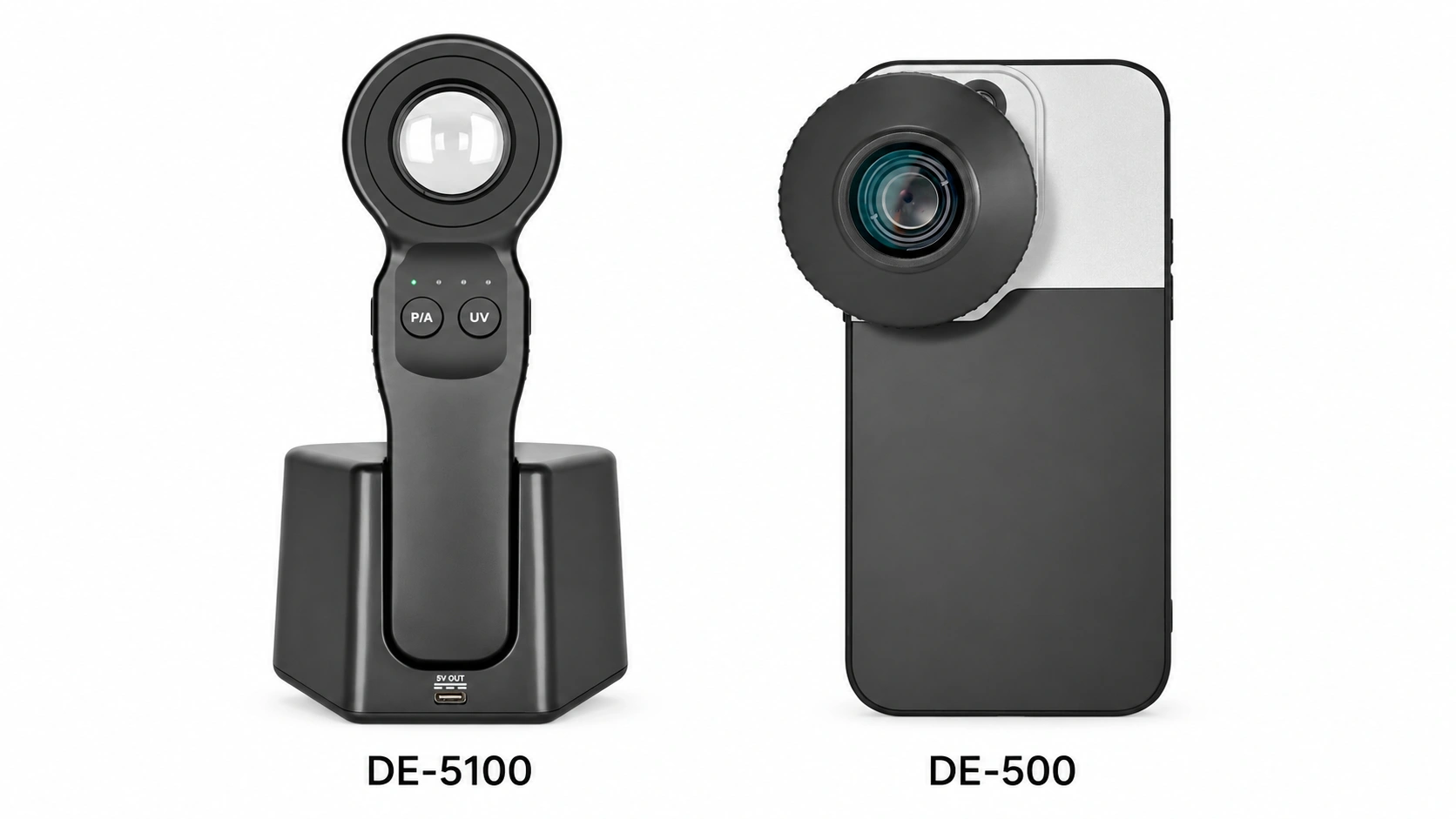
IBOOLO DE-5100 Dermatoscope
View DE-5100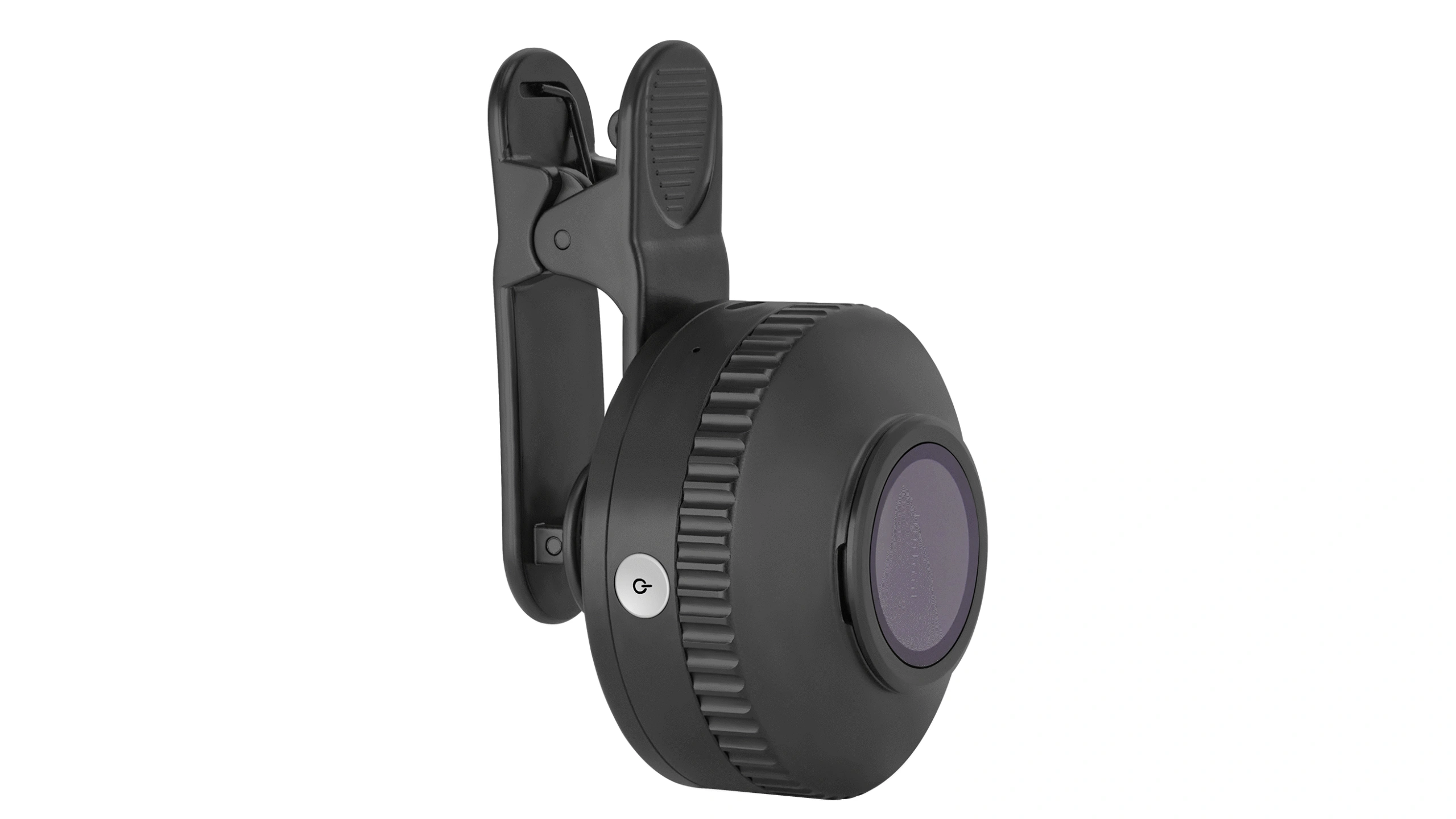
IBOOLO DE-500 Dermatoscope
View DE-500Why Should Pigmented Lesions Be Considered Before Cosmetic Treatment?
A brown or dark area on the skin should not automatically be treated as a cosmetic pigmentation problem. Melanocytic nevi, lentigines and other pigmented lesions may appear similar to an untrained observer, while their appropriate management can be very different.
This becomes particularly important before laser and light-based procedures. Research has shown that hair-removal lasers can produce visible and dermoscopic changes in melanocytic nevi, including changes in color, size, symmetry and pigment pattern. A 2023 systematic review concluded that these changes are not uncommon and recommended that nevi be assessed before laser hair removal when there is concern about atypia.
Other reports have described melanomas diagnosed in areas that had previously undergone laser treatment. These studies do not establish that cosmetic lasers cause melanoma; the more important concern is that treatment of an inadequately assessed pigmented lesion may alter its appearance and complicate or delay later diagnosis.
For a medical aesthetic clinic, the practical lesson is simple: an uncertain pigmented lesion should not be treated merely because the client came for a cosmetic procedure. Observation and documentation should come first, and referral should follow when the lesion requires medical assessment.
What Should a Medical Aesthetic Clinic Look for in a Dermatoscope?
For medical aesthetic clinics, the most useful dermatoscope is not necessarily the one with the largest number of functions. The device should match the way it will actually be used during consultation and treatment.
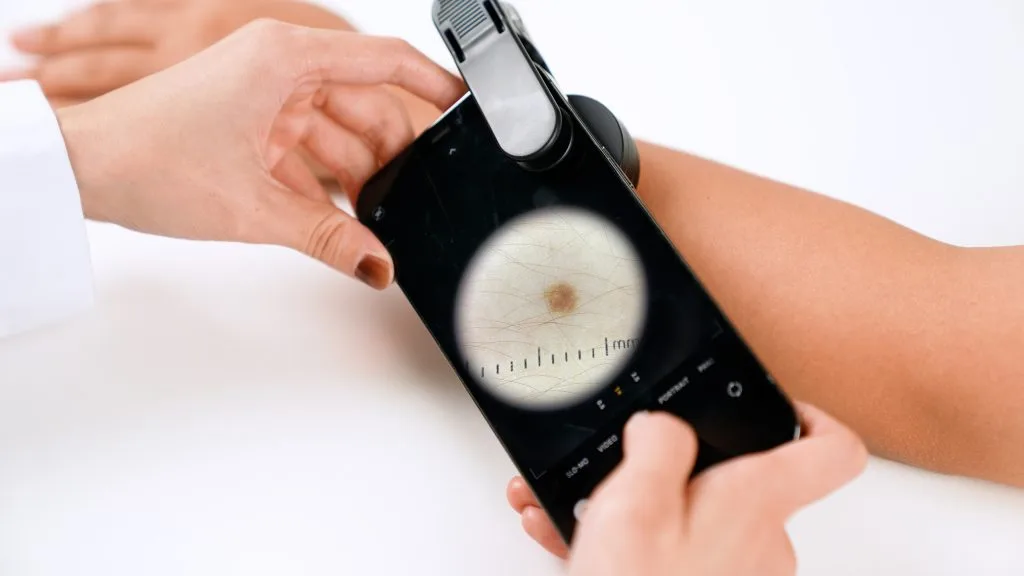
Polarized illumination is valuable because it reduces surface glare and provides additional information about structures below the immediate skin surface. A complementary surface-oriented mode can provide another view of superficial texture. Smartphone compatibility is particularly useful in aesthetic settings because it allows an observation to be converted quickly into an image record.
Portability also matters. In smaller clinics or facilities with several treatment rooms, a compact dermatoscope can move easily between consultation and treatment areas. In higher-volume medical aesthetic clinics, direct viewing, a larger optical field, adjustable brightness, longer battery life and a dedicated charging position may become more important.
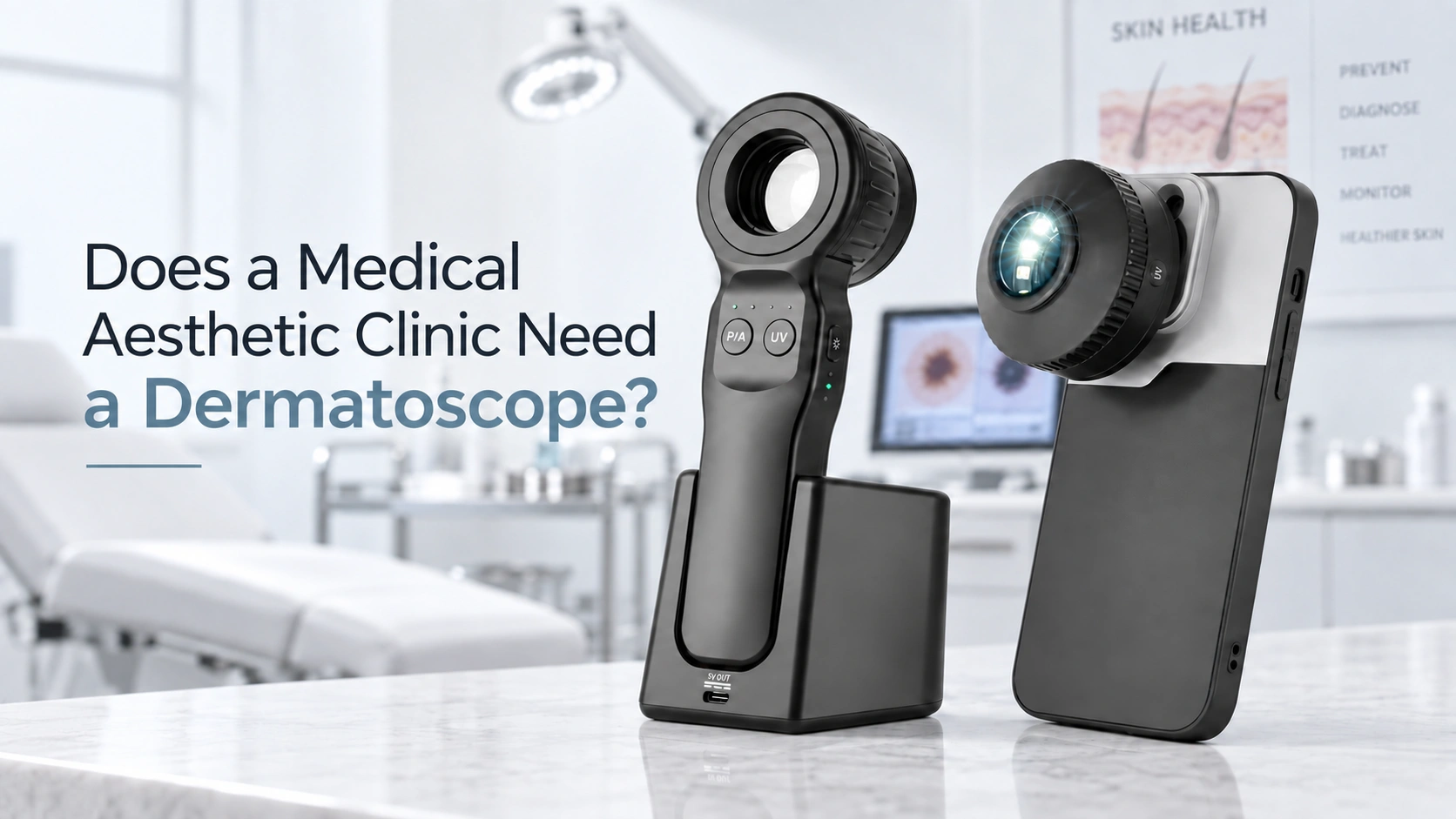
For this reason, IBOOLO currently focuses on two different workflows for this type of user: the compact DE-500 for mobile smartphone-based observation and the more complete DE-5100 for a fixed or high-frequency consultation environment.
How Do the IBOOLO DE-500 and DE-5100 Fit Different Aesthetic Workflows?
The DE-500 and DE-5100 are both designed for professional skin observation, but we developed them around different ways of working.
| Feature | IBOOLO DE-500 | IBOOLO DE-5100 |
| Magnification | 10X | 12X |
| Main Polarization Modes | Polarized and non-polarized | Cross-polarized and parallel-polarized |
| Additional Light | 365 nm UV | Amber light and 365 nm UV |
| Brightness Control | Fixed | 3 levels |
| Battery | 300 mAh | 1500 mAh |
| Observation Workflow | Smartphone / tablet | Direct viewing + digital imaging |
| Phone Connection | Magnetic phone adapter | Magnetic phone adapter |
| Main Aesthetic-Clinic Role | Portable observation and quick documentation | Multi-mode observation |
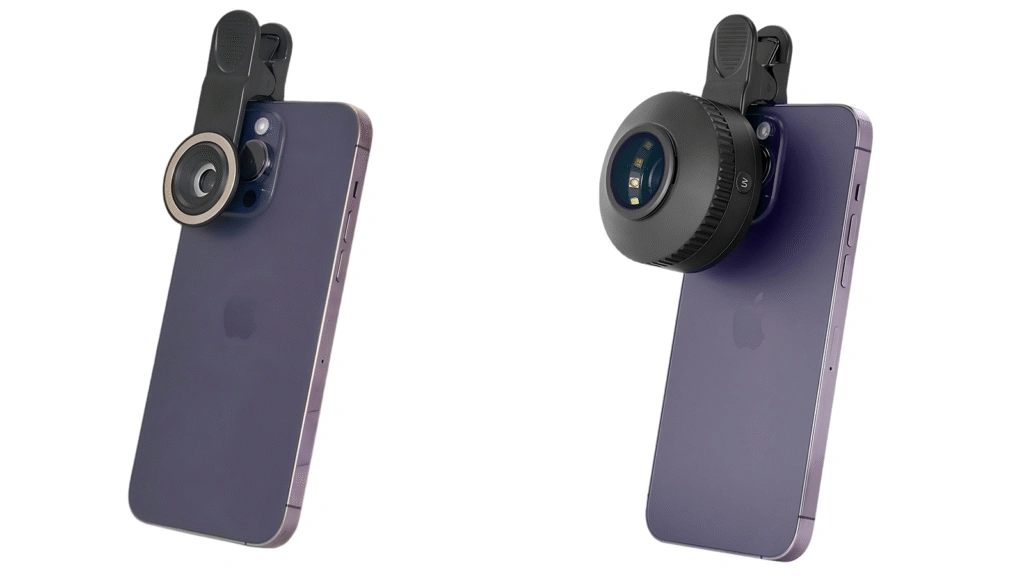
The IBOOLO DE-500 is designed around mobility. It provides 10X magnification, polarized and non-polarized illumination, 365 nm UV and a magnetic phone adapter. Its 300 mAh battery keep the system compact, making it practical when staff need to move between rooms or when smartphone documentation is the main workflow.
For an aesthetic clinic, this means the DE-500 can remain available as a small observation tool during consultation. When a client raises a question about a mole or another visible area, the device can be connected to a smartphone, used to record a close-up image and and then stored without occupying a permanent examination station.
The IBOOLO DE-5100 is built around a more structured clinical workflow. It provides 12X magnification, cross and parallel polarization, amber illumination, 365 nm UV, three brightness levels, a 1500 mAh battery and a charging stand. It also supports direct optical viewing and digital-device connection.
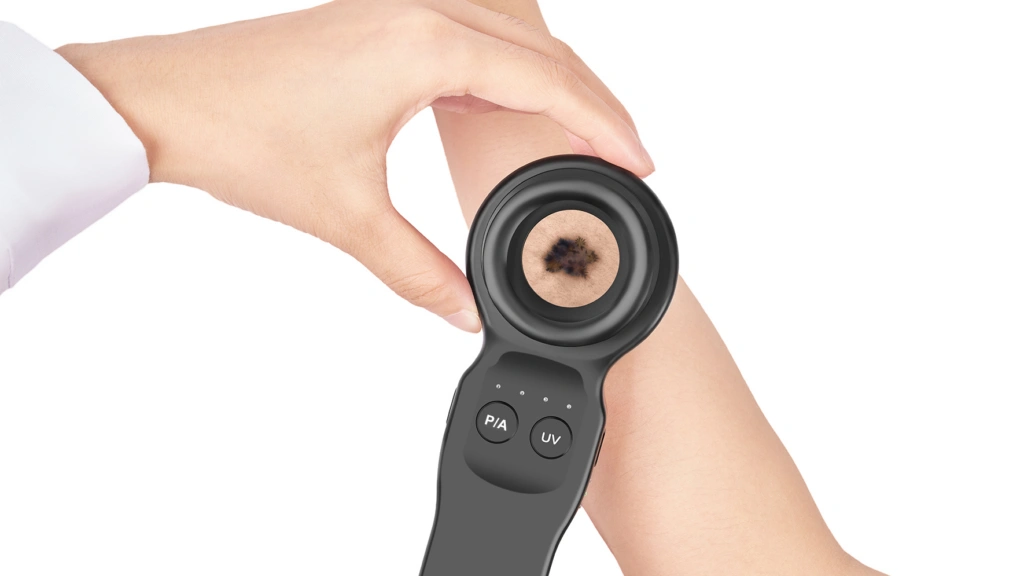
This configuration is particularly relevant to clinics where skin consultation is a routine part of the customer journey. The DE-5100 can remain on its charging stand in a consultation room, be used for direct examination, switch between several lighting modes when additional visual comparison is useful and then connect to a phone for documentation.
When Should an Aesthetic Clinic Refer a Client to a Dermatologist?
For medical aesthetic clinics, the ABCDE rule can provide a simple framework for recognizing pigmented lesions that deserve further medical assessment before a cosmetic procedure. It should be used as a referral guide rather than a diagnostic method.
A – Asymmetry: One half of the lesion looks different from the other.
B – Border: The border appears irregular, poorly defined or uneven.
C – Color: Several colors or uneven pigmentation are present within the same lesion.
D – Diameter: A diameter greater than about 6 mm may attract attention, although melanoma can also be smaller.
E – Evolving: The lesion is changing in size, shape, color or overall appearance.
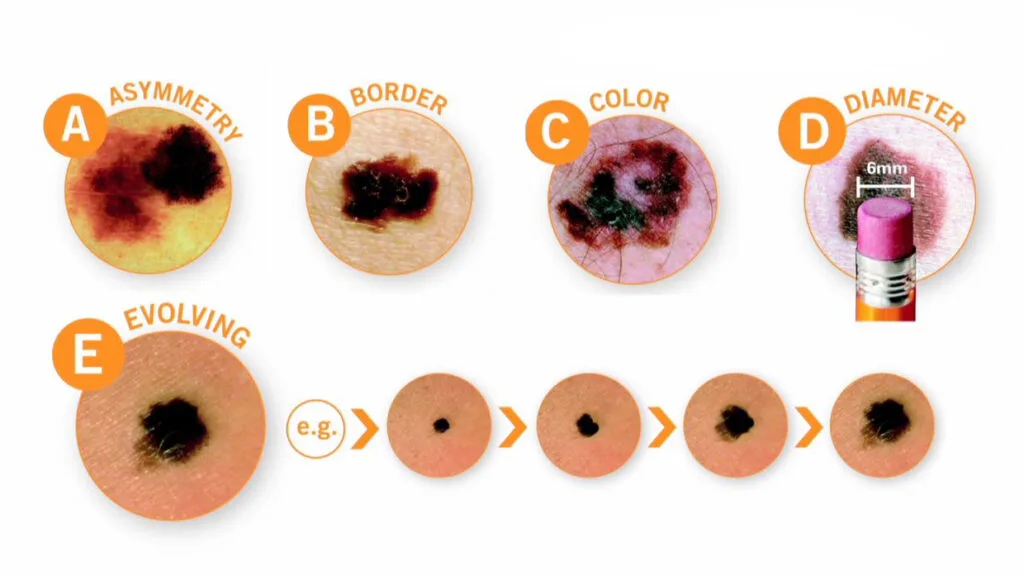
In an aesthetic consultation, particular attention should be paid to Evolving. If a client reports that a mole is new, growing or changing, or if the lesion shows one or more ABCDE features, the clinic should consider pausing cosmetic treatment over that area and recommend assessment by a dermatologist. Bleeding, crusting, persistent itching or other noticeable changes also warrant medical attention.
What Are the Most Common Questions About Dermoscopy in Aesthetic Clinics?
Does an aesthetic clinic need a dermatoscope?
Not every aesthetic clinic requires one, but a dermatoscope can be useful in medically supervised clinics that regularly examine skin before cosmetic treatment. It can support closer observation, image documentation and referral when a lesion requires medical assessment.
Should a mole be assessed before laser or hair-removal treatment?
If a mole appears uncertain or concerning, medical assessment before treatment is advisable. Laser hair removal can change the clinical and dermoscopic appearance of nevi, which may complicate later comparison.
How Can a Dermatoscope Support Pre-Treatment Assessment in an Aesthetic Clinic?
A dermatoscope can help trained professionals examine pigmented areas more closely before laser, IPL, hair removal, or other cosmetic procedures. It also allows clinics to capture baseline images for documentation and comparison.
Can dermatoscope images be captured with a smartphone?
Yes. The IBOOLO DE-500 uses a magnetic phone adapter for smartphone imaging, while the DE-5100 also supports digital-device connection. This makes it possible to integrate close-up images into an appropriate documentation workflow.
Which IBOOLO dermatoscope is suitable for a medical aesthetic clinic?
The DE-500 is designed for clinics that prioritize lightweight mobile observation and smartphone documentation. The DE-5100 is designed for more frequent consultation workflows requiring direct viewing, multi-mode illumination, adjustable brightness and a charging stand.