







Molluscum Contagiosum Dermoscopy: Clinical Patterns & Diagnosis | IBOOLO

Master molluscum dermoscopy with IBOOLO. Learn to identify the central umbilication, red crown vascular pattern, and polylobulated structures for accurate viral diagnosis.

Article

Dermoscopy of Molluscum

Molluscum is a worldwide epidemic mainly afflicting children in Papua, New Guinea and Fiji. The molluscum contagiosum virus (MCV) is a DNA virus member of the poxviridae family and is one of human beings’ biggest pathogenic weapons. Dermoscopy, which can magnify and display the lesion morphology in detail (including fine structure such as waxy sheen,…

Molluscum is a worldwide epidemic mainly afflicting children in Papua, New Guinea and Fiji. The molluscum contagiosum virus (MCV) is a DNA virus member of the poxviridae family and is one of human beings’ biggest pathogenic weapons. Dermoscopy, which can magnify and display the lesion morphology in detail (including fine structure such as waxy sheen, peripheral halo or central umbilicus of lesions that suggest Molluscum). These morphologic features become more apparent on dermoscopy and may assist in diagnosis confirmation.

What Is Molluscum?
MCV causes Molluscum, a self-limiting and benign cutaneous infection. Typically, a 2 to 8 mm diameter papule, solitary or multiple; round or hemispherical with waxy luster; central umbilicus concave. Molluscum is transmitted by direct contact, and it may also be spread through autologous inoculation or sexual transmission. Sexual transmission is rampant amongst sexually active youth and often linked with intercourse so that it happens to be considered as a STI.
The disease occurs mainly in children between the ages of 1 and 10 and in people with weakened immune systems, such as those who have leukemia, HIV, or are being treated for cancer. Skin damage can induce viral infection, the virus is easy to enter the human body through the broken skin to become infected. Sharing items with virus carriers in places such as public baths and swimming pools also increases the risk of infection.
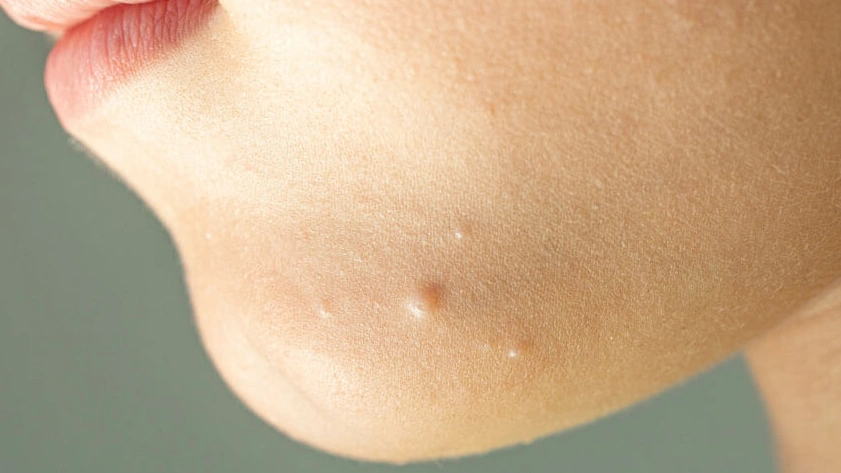
Molluscum
Molluscum

How To Identify Molluscum?
Molluscum is caused by a DNA poxvirus called MCV, it does not have an animal host and can only affect humans. It is classified as four types depending on the MCV type, MCV-1 to MCV-4. MCV-1 is the most common type and MCV-2 (found in adults) are typically spread sexually.
Molluscum lesions generally are hemispherical papules, gray or pearly in color, with a waxy surface that has the characteristic central indentation filled with whitish cheese-like grumous material of molluscumor; It is a common skin condition, and because of its symptoms mimic other notable skin conditions such as ordinary warts or papular urticaria or tellest sweat duct tumors.
Numerous combinations of diagnostic approaches for molluscum contagiosum have been developed. We can use dermoscopy to diagnose by a suspected lesion based on typical molluscum contagiosum features first. Histopathological examination can also be used. In the case of a molluscum contagiosum, a centrally depressed dome-shaped cyst filled with keratin is visible beneath the stratum corneum. The presence of molluscum contagiosum can be directly identified and confirmed by gently scraping the cuticle at the tip of the mollusc using a cotton swab and sending the sample to a laboratory to be analyzed for the presence of molluscum contagiosum vesicles.

Dermoscopic Features of Molluscum
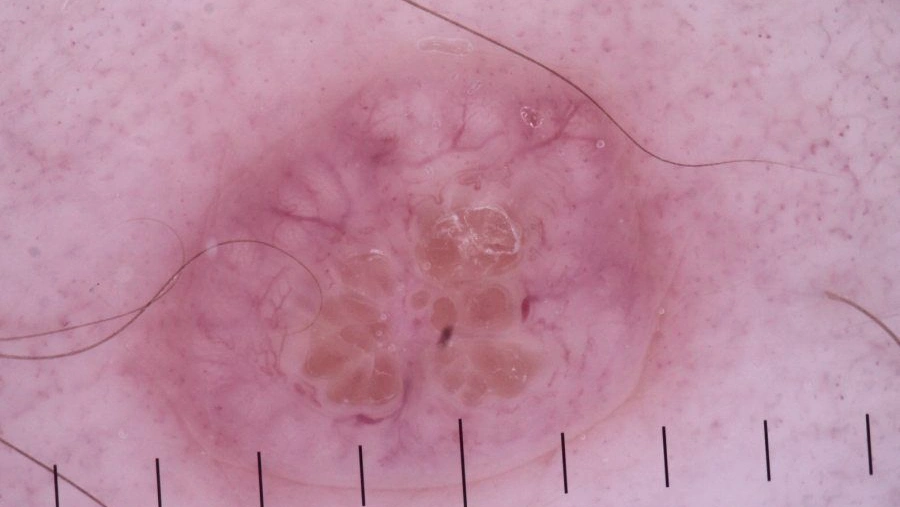
On dermoscopy molluscum shows a central umbilication and the surrounding white to yellow amorphous or multilobulated structures . At the periphery of the lesion, a network of linear or branching blood vessels can be clearly visualized in a distinctive “red crown” pattern, providing a key visual clue to the diagnosis of molluscum contagiosum.
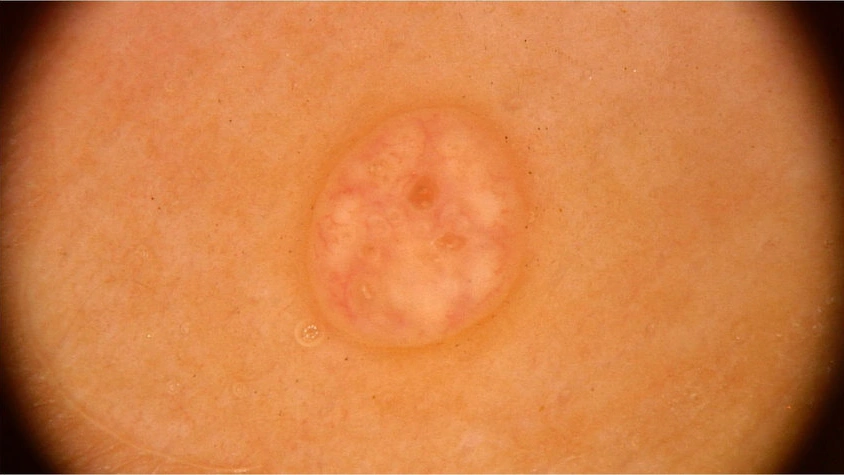
Dermoscopic Features of Molluscum

Differences between Molluscum and Other Skin Lesions
Using high-definition magnification with dermoscopy, molluscum contagiosum is easily discriminable from those other lesions of the skin. Central craters and multilobe white to yellowish amorphous structures were common dermoscopic features seen in molluscum contagiosum. The dermoscopic characteristics in basal cell carcinoma include a white structureless background, branching blood vessels and blue-gray dots. Dermoscopic features of keratoacanthoma typically consist of hemispherical or crateriform lesions with a central plug filled by keratin, and often an advancing growth at the margin.

Dermoscopy in the Treatment of Molluscum
Dermoscopy enables real-time observation of changes in molluscum during treatment, including subtle changes in its shape, size and color. For example, molluscum usually appears dermoscopically as an apical depression with a waxy sheen, which may diminish or disappear as treatment progresses, reflecting the effectiveness of the treatment. Furthermore, dermoscopy is a non-invasive procedure that requires no additional pain or discomfort for the patient. This makes it even more popular for monitoring the response to molluscum contagiosum treatment and evaluating efficacy.
Dermoscopy of Molluscum

Clinical and Dermoscopic Images of Molluscum
Molluscum contagiosum often presents clinically as a single or multiple translucent papules of varying sizes, mostly skin-colored or slightly whitish, sometimes with an umbilicus at the tip.
Dermoscopically, molluscum contagiosum lesions often appear as yellowish-white or white amorphous areas, due to the presence of viral particles and keratinized material within the lesions. The lesions are often surrounded by elongated vascular structures, which tend to be crowned or linear, and sometimes punctate.
Dermoscopy clearly shows the fine structure of the lesions and helps the doctor to make an accurate diagnosis. When molluscum contagiosum lesions are atypical or similar to other diseases, dermoscopic images allow doctors to differentiate molluscum contagiosum from other similar diseases (e.g., folliculitis, itchy rashes, sebaceous hyperplasia, etc.), thus avoiding misdiagnosis and underdiagnosis.


Treatment and Management of Molluscum
Common treatments for molluscum contagiosum are divided into two main categories: localized and systemic treatments.
Localized treatments include scraping, freezing and laser treatment. The first step is to use tweezers to scrape or pinch off the warts. The cold treatment is the use of liquid nitrogen’s low temperature effect to make the mollusc tissue necrosis and fall off. Laser treatment uses laser energy to vaporize or carbonize molluscum contagiosum and remove it. The prognosis of all four treatments is also affected by the patient’s immunity, the number and depth of treatments, and post-operative care.
Systemic treatment for molluscum contagiosum focuses primarily on improving the patient’s overall immunity and helping the body to naturally clear the virus. Commonly used immune-modulating drugs for this process include imiquimod cream and recombinant human interferon α2b. Systemic therapy focuses not only on the fading of the lesions, but also on improving the overall health of the patient. By improving the patient’s immunity, systemic therapy can reduce other complications caused by the disease and improve the patient’s quality of life.
Dermoscopy of Molluscum Contagiosum: A Clinical Guide to Identification

Molluscum Contagiosum (MC) is a common viral skin infection caused by a DNA poxvirus. While the diagnosis is often clinical, molluscum dermoscopy has become an essential tool for identifying atypical presentations and distinguishing these lesions from more concerning conditions like basal cell carcinoma or cryptococcosis. This guide explores the hallmark dermoscopic signatures of MC and how advanced optics enhance diagnostic confidence.

The Diagnostic Triad: Recognizing the Poxvirus Signature

The accuracy of molluscum dermoscopy relies on recognizing a specific combination of structural and vascular patterns. When viewed under high-resolution optics, these features reveal the underlying viral colony within the epidermis.

1. Central Umbilication and Pore

The most pathognomonic feature is the central umbilication, which corresponds to the clinical "dimple." Under the dermascope, this indentation often reveals a central pore containing whitish or yellowish amorphous material. This material consists of the "molluscum bodies" (Henderson-Paterson bodies), which are keratinocytes filled with viral particles.

2. Polylobulated White-Yellowish Structures

A key finding in dermoscopy of molluscum is the presence of white-to-yellowish amorphous structures that appear lobulated or "cloud-like." These structures represent the enlarged, infected hair follicle units and are more clearly visualized using the 10x magnification of devices like the IBOOLO DE-4100 Pro.

3. The "Red Crown" Vascular Pattern

The vascular architecture of a molluscum lesion is highly characteristic. Clinicians will typically observe a network of linear, slightly blurred vessels at the periphery of the lesion. These vessels form a ring or "crown" around the central lobules but, importantly, do not cross the center of the lesion—a vital differentiator from malignant tumors.

Differential Diagnosis: Molluscum vs. Mimics

Feature Molluscum Contagiosum Sebaceous Hyperplasia Common Warts
Central Feature Central pore with viral bodies. Central umbilication (duct). Absent (Papillary surface).
Vessels Red Crown (Peripheral only). Crown vessels (Thin/Monomorphic). Dotted/Looped (Thrombus-like).
Internal Color White-Yellow (Opaque). Creamy-Yellow (Lobular). Skin-colored or gray.

Special Considerations: Adult and Immunocompromised Patients

While MC is primarily a pediatric condition, its appearance in adults—particularly in the genital region—requires careful screening for other STIs. In immunocompromised patients (such as those with HIV), lesions may lack the classic central umbilication and appear as large, pearly nodules. Utilizing polarized dermoscopy is critical in these cases to identify faint vascular clues that suggest the underlying viral etiology.

Enhancing Diagnostic Precision with IBOOLO Optics

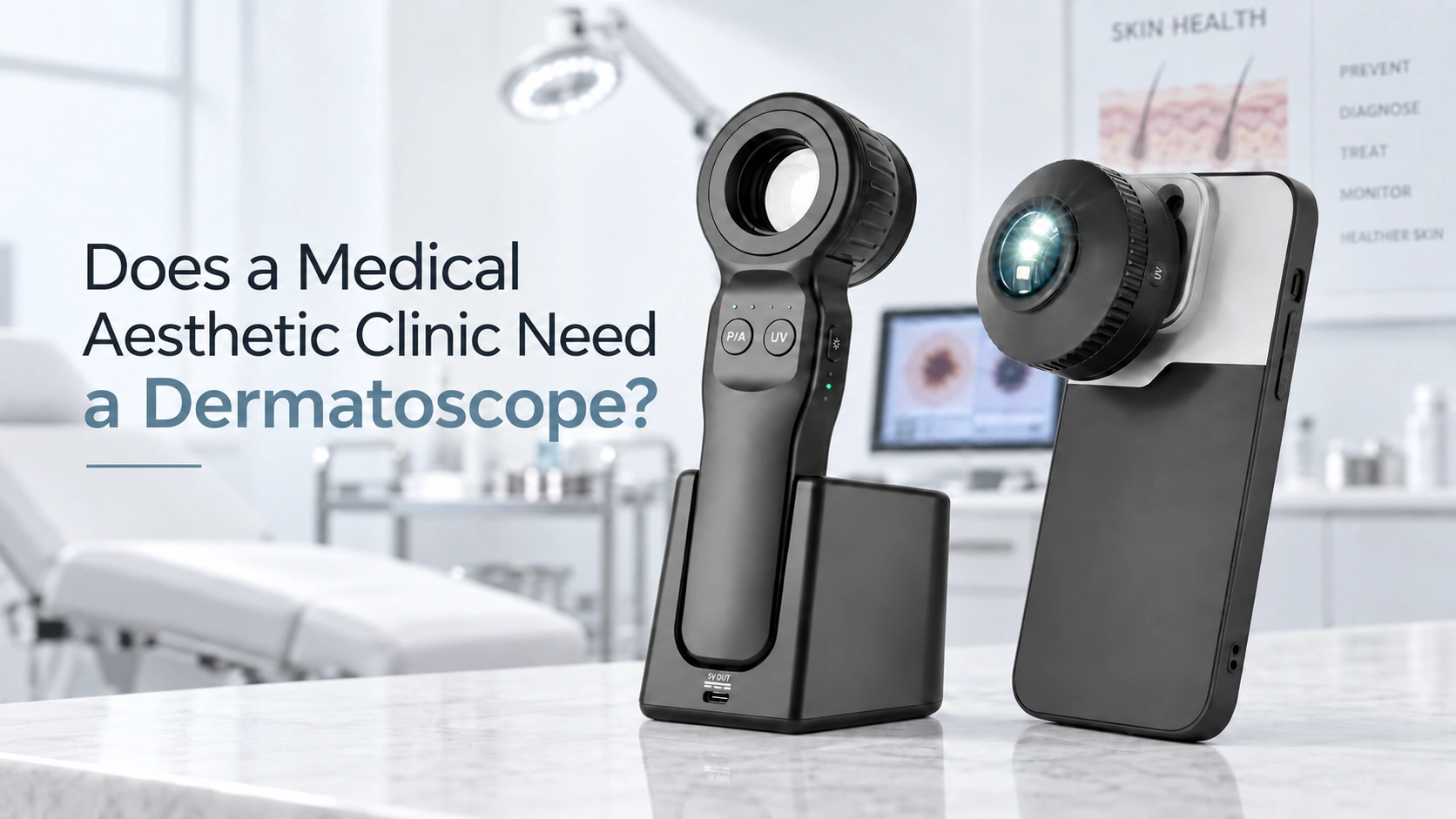
The subtle "Red Crown" vessels and the texture of internal lobules in molluscum dermoscopy require hardware capable of high-contrast imaging. IBOOLO dermatoscopes support the clinician's workflow through: - High-Resolution Optical Glass: Minimizes chromatic aberration, ensuring the "Red Crown" is accurately colored. - Cross-Polarization: Essential for viewing the deeper vascular patterns without the glare of the waxy lesion surface. - Smartphone Linkage: Allows for teledermatology, enabling pediatricians to share images with dermatology specialists for rapid confirmation.

Frequently Asked Questions

Can dermoscopy distinguish molluscum from Basal Cell Carcinoma (BCC)?

Yes. BCC typically features arborizing (tree-like) vessels that cross the center, whereas molluscum vessels are restricted to the periphery in a crown-like arrangement.

Is it necessary to use immersion oil for molluscum?

While oil can enhance transparency, the cross-polarized light mode on the IBOOLO DE-3100 is generally sufficient and more hygienic for observing viral lesions.

Do all molluscum lesions show a central pore?

Most mature lesions do, but very early or regressing lesions may only show the vascular "Red Crown" or a faint white structureless area.

Share this article

0

No products in the cart.

Ask

Have questions on gear or your order?

Our Gear Guides are here to help! Get personal advice from pro creatives

Name
Subject
Email address
How can we help?
Answers

Instant Answers

How can dermoscopy images be captured?

Dermoscopy images can be captured and stored in different ways, such as: • Using a smartphone or tablet with dermoscopic adapter, which consisted in the package.• Using a digital camera

Dermoscopy images can be captured and stored in different ways, such as:

• Using a smartphone or tablet with dermoscopic adapter, which consisted in the package.
• Using a digital camera with dermoscopic adapter, there’s 49mm screw size camera adapter available to order now.

Compatible phone/tablet models:
All iPhone models, 95% Android phones, 90% tablet. For phone/tablet size in 5.25-14mm

Compatible camera models:
All camera with built 49mm filter screw, such as Canon EOS 70D, 80D, 90D; Canon EOS R7, R10, R50, R100; Canon M100, M200, M50, Mark II; Canon G7X Mark III, Sony ZV-1

How can I connect my phone to my dermatoscope?

There’s universal phone adapter for all our dermoscopes. Please check the installation procedure bellow or watch operation guide. Smartphone Connector (1) Place phone adapter screw in the center of smartphone’s

There’s universal phone adapter for all our dermoscopes. Please check the installation procedure bellow or watch operation guide.

Smartphone Connector

(1) Place phone adapter screw in the center of smartphone’s main camera.
(2) Screw magnet attachment on phone adapter.
(3) Put dermoscope’s back ring and magnet attachment together

Take The Best Images

You need to adjust the focus ring after the dermoscpe connected on smartphone to get the best images.

How can I clean my dermoscopy after usage?

Cleaning your dermoscopy after usage is important to prevent cross-contamination and infection. The cleaning method may vary depending on the type and model of your dermoscopy, so you should always

Cleaning your dermoscopy after usage is important to prevent cross-contamination and infection. The cleaning method may vary depending on the type and model of your dermoscopy, so you should always follow the manufacturer’s instructions. However, some general steps are:

• Turn off and disconnect your dermoscopy from any power source or device.

• Wipe off any visible dirt or debris from the dermoscopy with a soft cloth or tissue.

• Disinfect the dermoscopy with an alcohol-based wipe or spray, or a disinfectant solution recommended by the manufacturer. Make sure to cover all surfaces, especially the lens and contact plate.

• Let the dermoscopy air dry completely before storing it in a clean and dry place.

• Do not use abrasive or corrosive cleaners, solvents, or detergents that may damage the dermoscopy.

• Do not immerse the dermoscopy in water or any liquid, unless it is waterproof and designed for immersion.

You should clean your dermoscopy after each use, or at least once a day if you use it frequently. You should also check your dermoscopy regularly for any signs of damage or malfunction, and contact the manufacturer or service provider if needed.

Polarized VS Non-polarized Dermoscopy

A dermoscopy is a device that allows the examination of skin lesions with magnificationand illumination. By revealing subsurface structures and patterns that are not visible tothe naked eye. It can

A dermoscopy is a device that allows the examination of skin lesions with magnificationand illumination. By revealing subsurface structures and patterns that are not visible tothe naked eye. It can improve the diagnose accuracy of skin lesions, such as melanoma,basal cell carcinoma, seborrheic keratosis, etc.

There are two main types of dermoscopy: Non polarized and polarized dermoscopy.We’ve fitted most of our dermoscopys with polarized and non-polarized light. They canbe used in multiple skin structures.

Non-polarized contact Mode

In non-polarized mode, the instrument can provide information about the superficialskin structures, such as milia-like cysts, comedo-like openings, and pigment in theepidemis.

The dermoscopy requires applying a liquid such as mineral oil or alcohol to the skin andplacing the lens in contact with the skin. This reduces surface reflection and enhancesthe view of subsurface structures.

Image with non-polarized light (DE-3100)

Polarized contact Mode

In polarized mode, the instrument allows for visualization for deeper skin structures,such as blood vessels, collagen, and pigment in the dermis.

The dermoscopy does not need to be in contact with the skin or use any liquid. Theirpolarized light can help to eliminate surface reflection and allow visualization ofvascular structures.

Image with polarized light (DE-3100)

Polarized non-contact Mode

The dermoscopy can also use polarized light to examine the skin without direct contact.

In polarized non-contact mode, the instrument allows for examination infected areasand lesions that are painful for the patient, or the difficult to contact pigmented lesions,such as nails and narrow areas.

The contact plate should be removed in this mode, and it does not require applying aliquid to the skin. As it doesn’t require pressure or fluid application on the skin, it canalso avoid cross-contamination and infection risk.

Image in polarized non-contact mode (DE-3100)

How effectiveness is dermoscopy

Compared with visual inspection, the dermoscopy can be used to capture and store skin lesion photos, which play an important role in early skin cancer examination. The dermoscopy allows the

Compared with visual inspection, the dermoscopy can be used to capture and store skin lesion photos, which play an important role in early skin cancer examination.

The dermoscopy allows the examination of skin lesions with magnification and illumination. This can be greatly avoiding the factors that cause interference to visual detection. Such as lighting, skin color, hair and cosmetics.

Several studies have demonstrated that dermoscopy is useful in the identification of melanoma, when used by a trained professional.

It may improve the accuracy of clinical diagnosis by up to 35%
It may reduce the number of harmless lesions that are removed
In primary care, it may increase the referral of more worrisome lesions and reduce the referral of more trivial ones

A 2018 Cochrane meta-analysis published the accuracy of dermoscopy in the detection.

Table 1. Accuracy of dermoscopy in the detection of melanoma in adults
Detection Method Sensitivity, % Specificity, % Positive Likelihood Ratio NegativeLikelihood Ratio
Visual inspection alone (in person) 76 75 3.04 0.32
Dermoscopy with visual inspection (in person) 92 95 18 0.08
Image-based visual inspection alone (not in person) 47 42 0.81 1.3
Dermoscopy with image-based visual inspection (not in person) 81 82 4.5 0.23
ROC—receiver operating characteristic. *Estimated sensitivity calculated on the summary ROC curve at a fixed specificity of 80%.

As we can see, the dermoscope can improve the accuracy of diagnosis of skin lesions, especially melanoma.

Table 1. Accuracy of dermoscopy in the detection of melanoma in adults
Detection Method Sensitivity, % Specificity, % Positive Likelihood Ratio NegativeLikelihood Ratio
Visual inspection alone (in person) 79 77 3.4 0.27
Dermoscopy with visual inspection (in person) 93 99 93 0.07
Image-based visual inspection alone (not in person) 85 87 6.5 0.17
Dermoscopy with image-based visual inspection (not in person) 93 96 23 0.07
ROC—receiver operating characteristic. *Estimated sensitivity calculated on the summary ROC curve at a fixed specificity of 80%.

Characteristics of the dermatoscopic structure of the skin lesions include:

• Symmetry or asymmetry
• Homogeny/uniformity (sameness) or heterogeny (structural differences across the lesion)
• Distribution of pigment: brown lines, dots, clods and structureless areas
• Skin surface keratin: small white cysts, crypts, fissures
• Vascular morphology and pattern: regular or irregular
• Border of the lesion: fading, sharply cut off or radial streaks
• Presence of ulceration

There are specific dermoscopic patterns that aid in the diagnosis of the following pigmented skin lesions:

• Melanoma
• Moles (benign melanocytic naevus)
• Freckles (lentigos)
• Atypical naevi
• Blue naevi
• Seborrhoeic keratosis
• Pigmented basal cell carcinoma
• Haemangioma

We use cookies on this website to provide a better user experience. By continuing to browse the website, you are giving your consent to receive cookies on this site. For more details please read our Privacy Policy.

Hot Search Terms