




Maintenance Protocol: How to Extend the Lifespan of Your IBOOLO Dermatoscope – IBOOLO

Shenzhen Iboolo Optics Co.Ltd established in 2012, with more than 11+ years. We have been specialized in the field of Macro lens, Woods Lamp, Dermatoscope and Microscope, and so on. We are a high-tech company integrated with research, manufacture and marketing.

Article

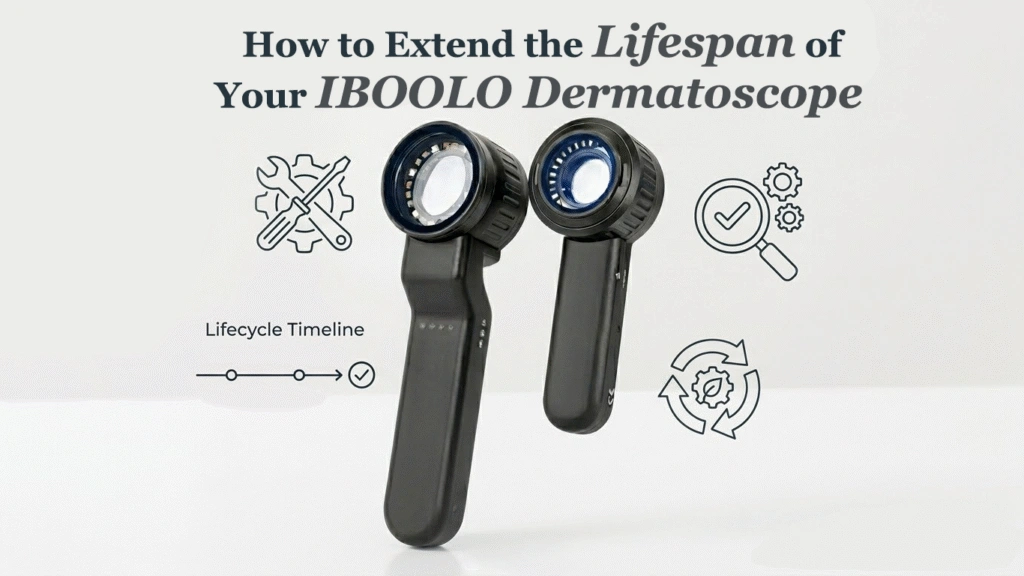
Maintenance Protocol: How to Extend the Lifespan of Your IBOOLO Dermatoscope

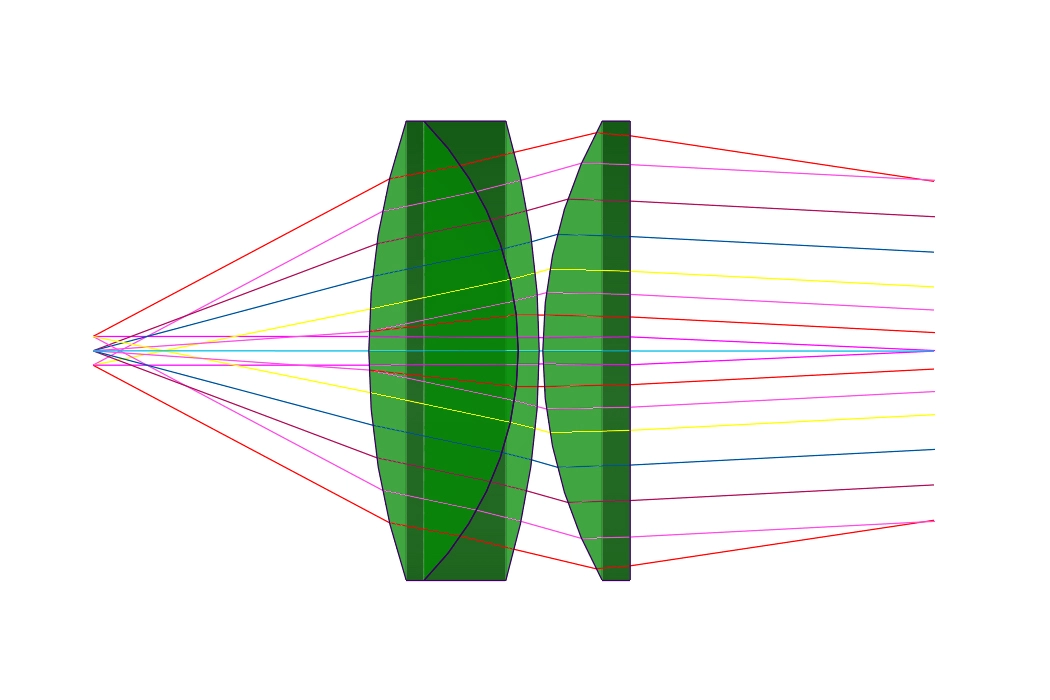
Optical clarity is the cornerstone of accurate dermatological assessment. The achromatic lens system used in devices such as the IBOOLO DE-4100 Dermatoscope relies on precision multi-layer coatings to minimize chromatic aberration and maximize true-to-life color rendering. Even microscopic smudges, oil residue, or chemical corrosion can distort light transmission, reduce contrast, and ultimately interfere with clinical…

Optical clarity is the cornerstone of accurate dermatological assessment. The achromatic lens system used in devices such as the IBOOLO DE-4100 Dermatoscope relies on precision multi-layer coatings to minimize chromatic aberration and maximize true-to-life color rendering. Even microscopic smudges, oil residue, or chemical corrosion can distort light transmission, reduce contrast, and ultimately interfere with clinical judgment. So Maintaining the structural and functional excellence of your device is not merely about aesthetics—it is about preserving the clinical accuracy of every examination.

How Should You Clean Your Dermatoscope Lenses for Maximum Clarity?

Proper optical maintenance requires a balance between effective disinfection and the preservation of delicate lens coatings. To ensure your DE-4100 or DE-500 remains in peak condition, follow these rigorous cleaning standards:

Recommended Procedures: Use 75% isopropyl alcohol prep pads to gently wipe the contact plate and outer lens surfaces. For dry debris or fingerprints on the internal optics, utilize the IBOOLO Professional Lens Cleaning Pen. Its carbon-based tip is specifically designed to lift oils without leaving streaks or micro-abrasions.

Prohibited Actions: Never rinse the device directly under running water or submerge it in liquid, as this can breach the internal optical seals. Avoid aggressive industrial solvents, bleach, or highly concentrated ammonia, which can permanently strip the anti-reflective achromatic coatings.

Note: If your imaging is losing its edge due to surface damage, don’t compromise your diagnosis. Click here to get genuine replacement contact plates for the DE-4100.
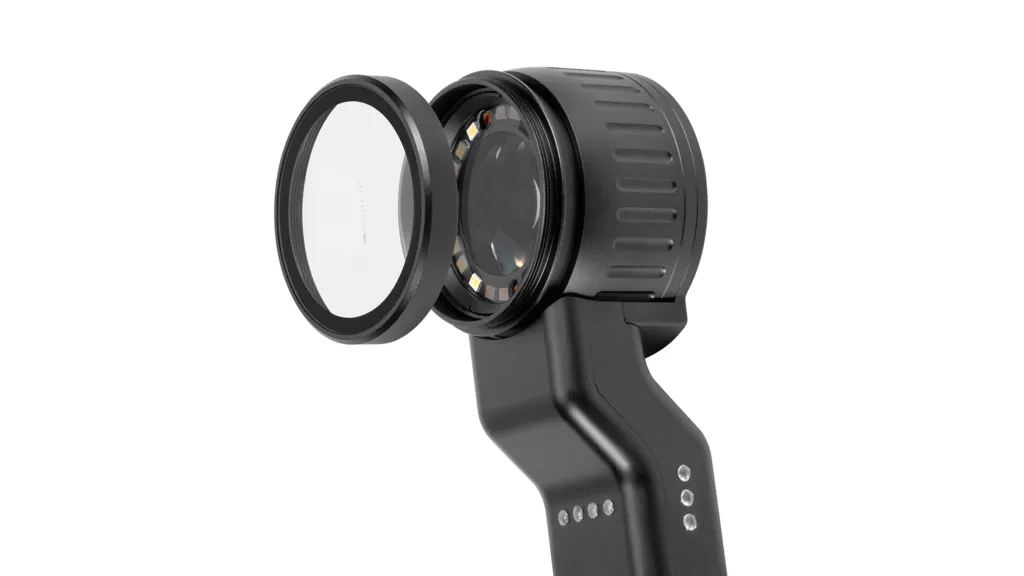
IBOOLO DE-4100 contact plate
IBOOLO Contact Plate for DE-4100

How to Properly Use IBOOLO Disposable Cross-Infection Covers?

Hygiene is paramount in dermatology, but infection control must not compromise optical performance. IBOOLO disposable cross-infection guards are engineered to be ultra-thin and optically transparent to ensure patient safety doesn’t hinder your view.

(1) Preparation: Ensure the permanent contact plate is clean before applying the disposable cover. Any trapped dust will be magnified under the 10x lens.

(2)Application: Align the guard with the rim of the DE-4100. Press firmly around the edges to ensure a flat, taut surface across the lens. Air bubbles or wrinkles can cause light refraction, leading to distorted imaging.

(3)Standardized Hygiene: These covers are strictly single-use. Remove and discard immediately after the exam to prevent any adhesive residue from curing on the primary lens.
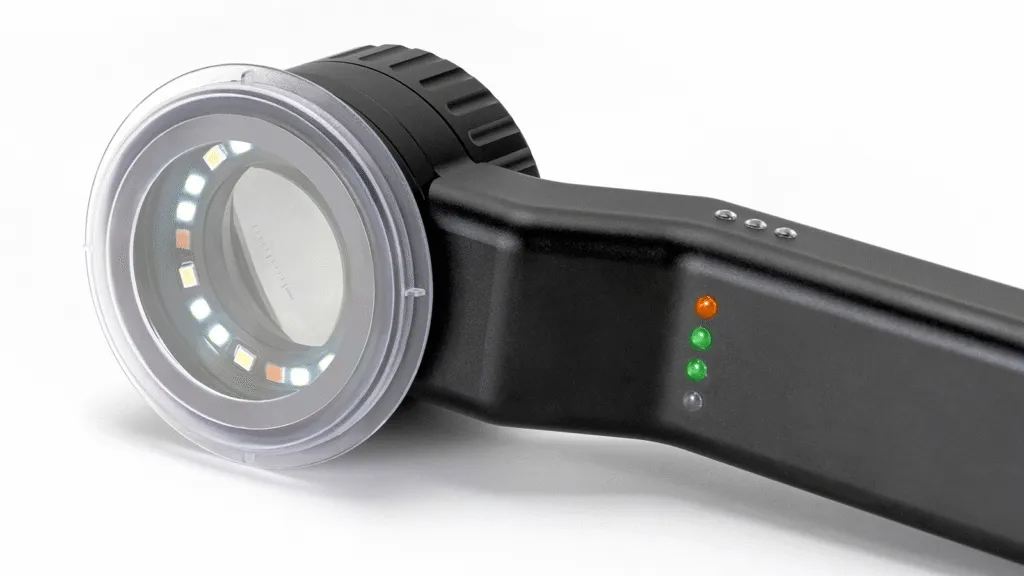
Disposable protective cover for DE-4100
Disposable Protective Cover for DE-4100

How Can You Optimize Battery Longevity in a Clinical Environment?

The battery capacity for the DE-3100 and DE-3100 PRO is 1000mAh, while that for the DE-4100 and DE-4100 PRO is 1500mAh. The high-capacity lithium batteries are designed for thousands of charge cycles, but their lifespan is heavily influenced by user habits.

The “Top-Up” Strategy: Modern lithium-ion technology thrives on frequent, short charging sessions. Unlike older battery types, there is no “memory effect.” We strongly recommend charging as you go—placing the device on its charger between patients—rather than waiting for the battery to deplete entirely.

Avoid Deep Discharge: Frequent total discharge (letting the battery hit 0%) puts significant chemical stress on the cells. Keeping the battery level between 20% and 80% is the most effective way to extend the total years of service for your clinical equipment.

How to Protect the High-Precision Etched Glass in the IBOOLO Dermatoscope?

Both the DE-500 and the IBOOLO handheld dermatoscope series feature professional etched glass technology, which ensures that the measurement scales are physically engraved into the lens for permanent clarity.

While etched scales won’t fade like silk-screened ones, skin oils or sunscreen residues can settle into the microscopic etched grooves, causing light refraction. Always use 75% alcohol to clean the lens immediately after a few minutes of examination. If you use the new IBOOLO disposable contact covers, you can bypass this step entirely, effectively shielding the optics from direct contact with contaminants.
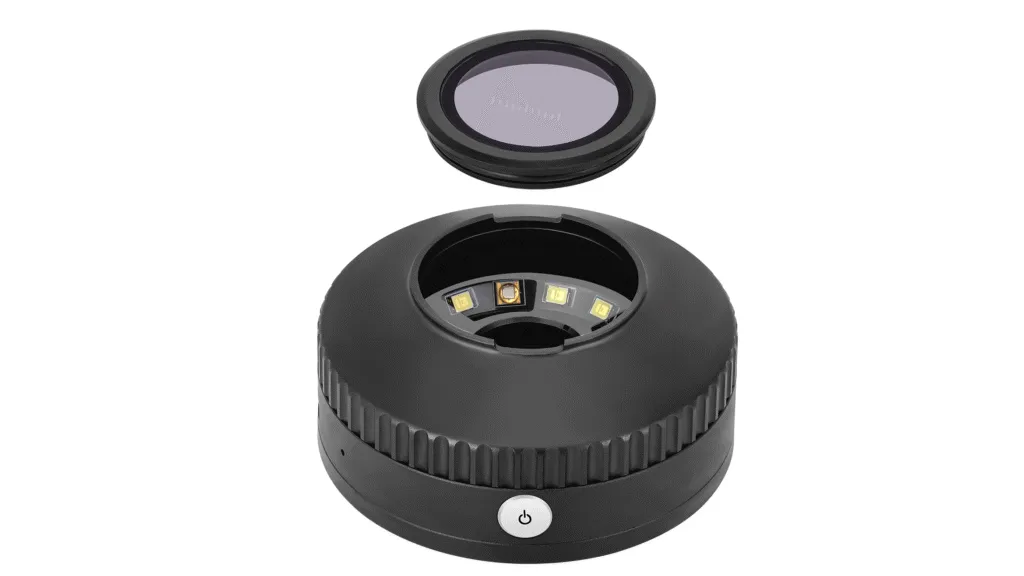
Etched Glass of DE-500

Where is the Ideal Environment to Store Your IBOOLO Dermatoscope?

Even the most meticulous cleaning and battery care routines cannot compensate for improper storage. To truly extend the lifespan of your dermatoscope, the device should be stored in a cool, dry environment away from direct sunlight, excessive humidity, or heat sources. Stable environmental conditions help preserve optical coatings, prevent internal condensation, and protect lithium battery chemistry from premature degradation.

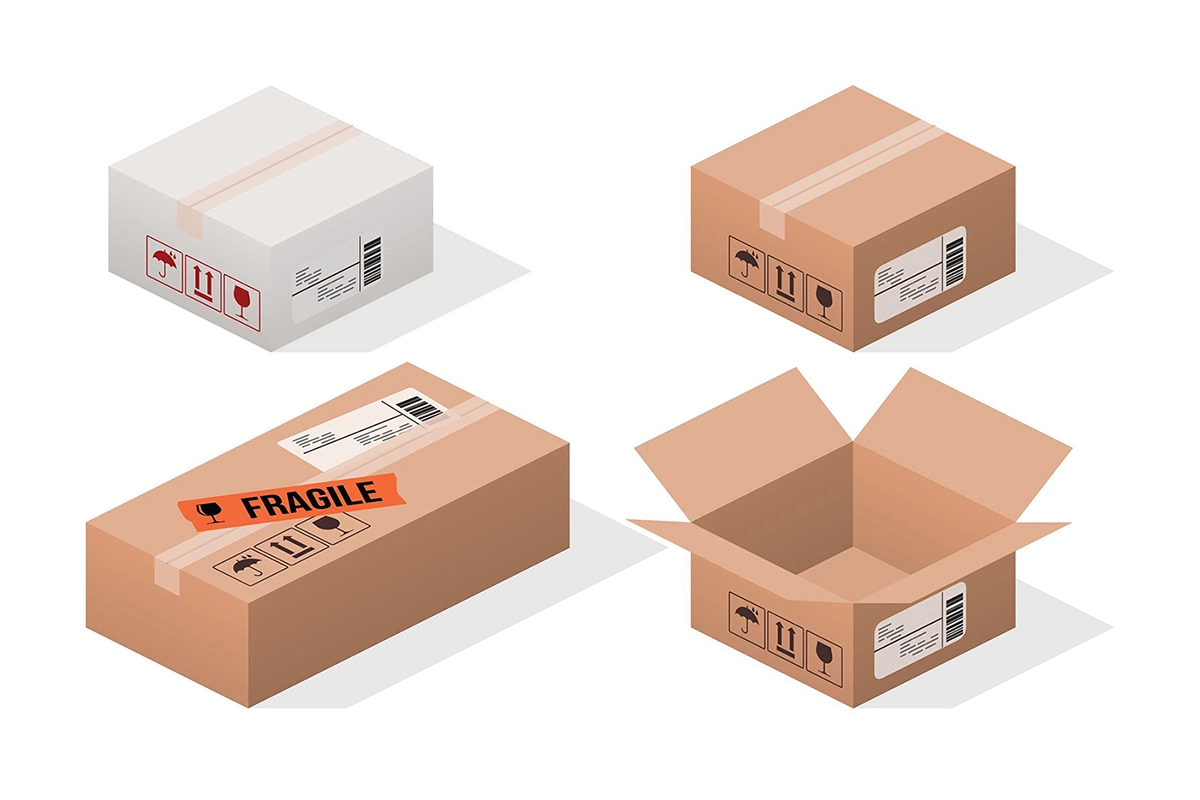
During transportation or mobile consultations, always use the original manufacturer’s protective case. The fitted interior cushioning minimizes vibration and impact, preventing subtle optical misalignment or lens surface damage that may not be immediately visible but can gradually affect image clarity.
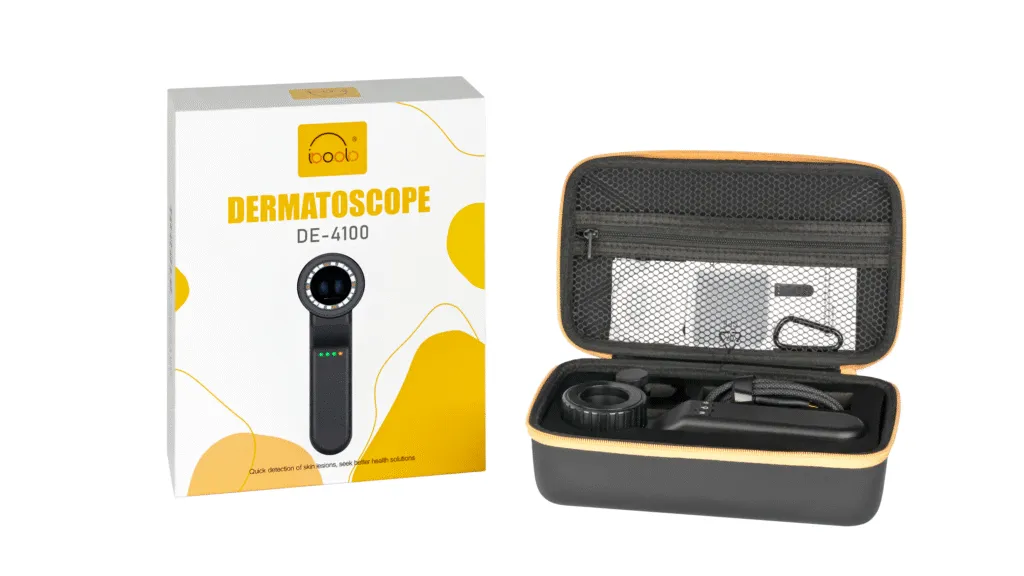
IBOOLO DE-4100 Package1
DE-4100 Package

What Support Will You Receive If You Purchase an IBOOLO Dermatoscope?

When you purchase any model of IBOOLO dermatoscope, you will receive a 2-year warranty period. This means that should any quality issues arise within 2 years, we will provide complimentary repairs or replacements for free. Furthermore, our team of professional engineers is available to assist should you encounter any difficulties during use. Please feel free to email us at help@iboolooptics.com at any time, and we shall respond promptly.
Share this article

0

No products in the cart.

Ask

Have questions on gear or your order?

Our Gear Guides are here to help! Get personal advice from pro creatives

Name
Subject
Email address
How can we help?
Answers

Instant Answers

How can dermoscopy images be captured?

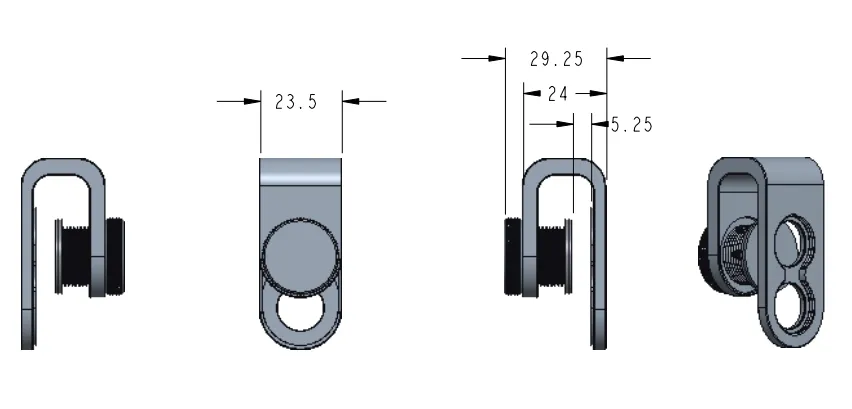
Dermoscopy images can be captured and stored in different ways, such as: • Using a smartphone or tablet with dermoscopic adapter, which consisted in the package.• Using a digital camera

Dermoscopy images can be captured and stored in different ways, such as:

• Using a smartphone or tablet with dermoscopic adapter, which consisted in the package.
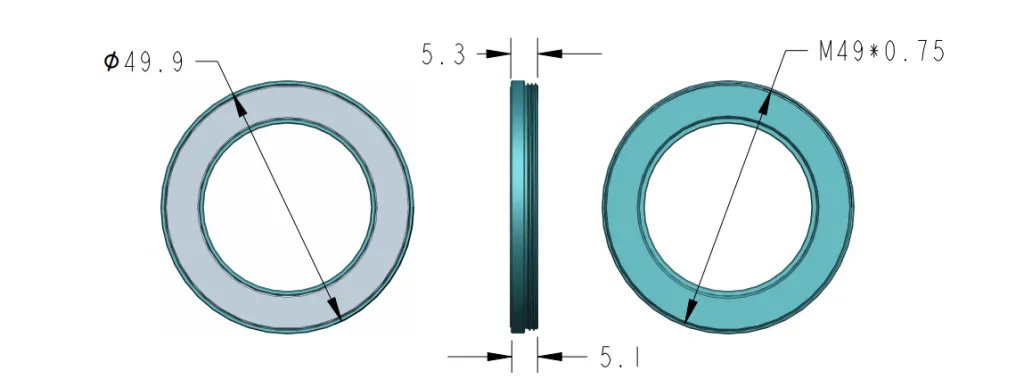
• Using a digital camera with dermoscopic adapter, there’s 49mm screw size camera adapter available to order now.

Compatible phone/tablet models:
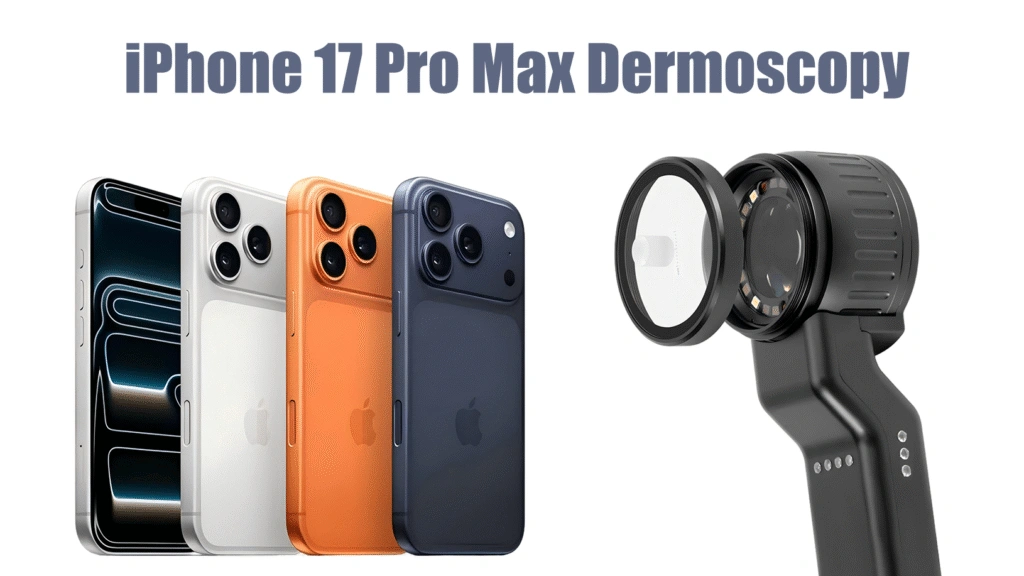
All iPhone models, 95% Android phones, 90% tablet. For phone/tablet size in 5.25-14mm

Compatible camera models:
All camera with built 49mm filter screw, such as Canon EOS 70D, 80D, 90D; Canon EOS R7, R10, R50, R100; Canon M100, M200, M50, Mark II; Canon G7X Mark III, Sony ZV-1

How can I connect my phone to my dermatoscope?

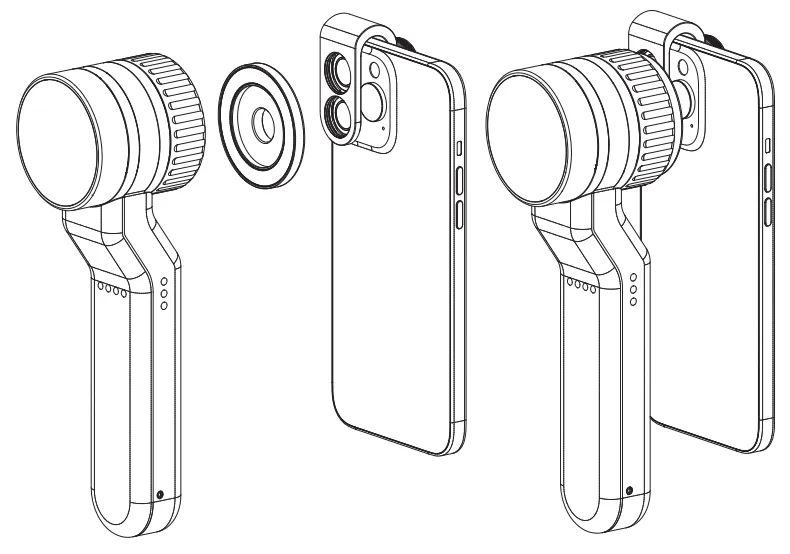
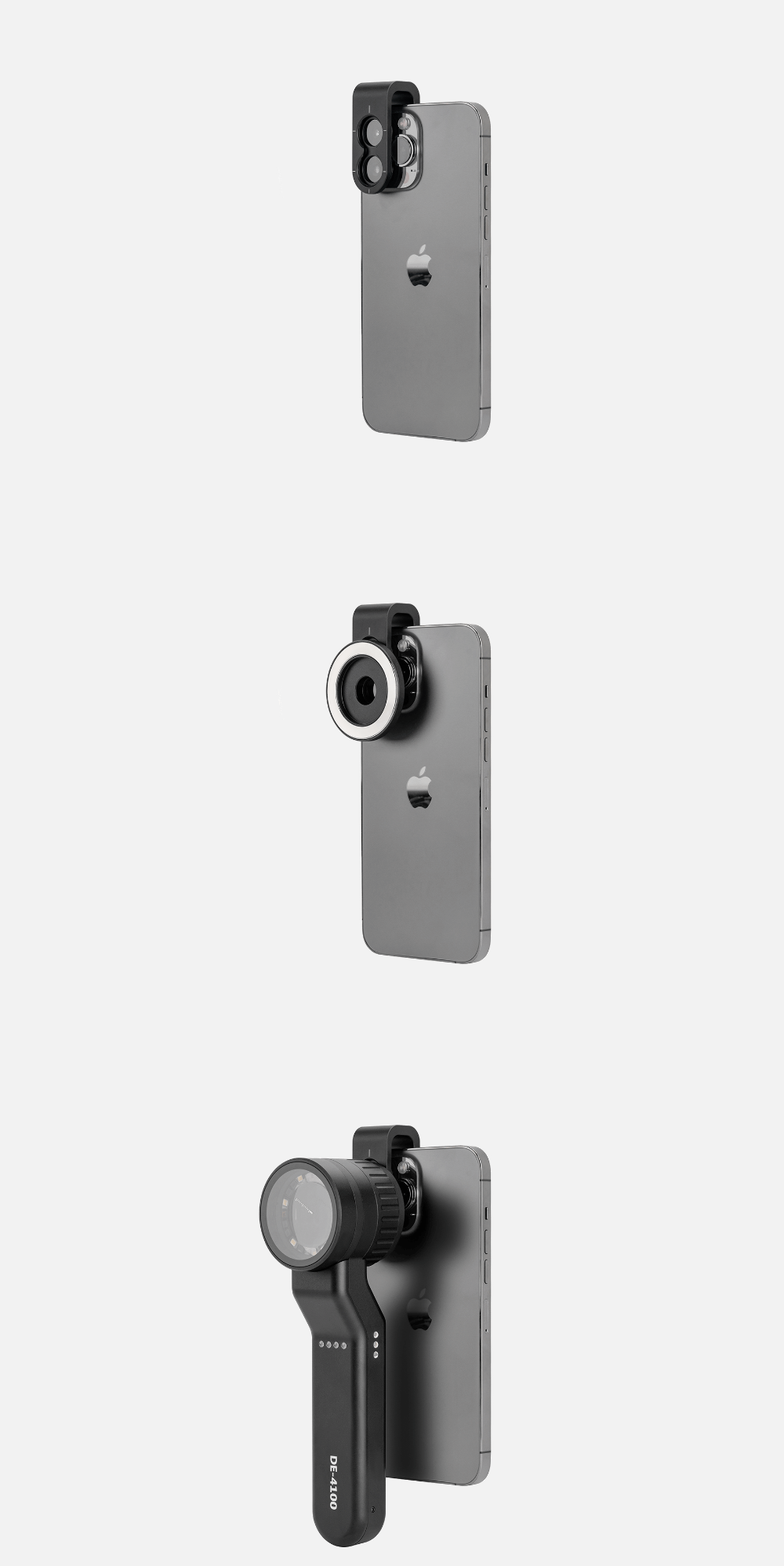
There’s universal phone adapter for all our dermoscopes. Please check the installation procedure bellow or watch operation guide. Smartphone Connector (1) Place phone adapter screw in the center of smartphone’s

There’s universal phone adapter for all our dermoscopes. Please check the installation procedure bellow or watch operation guide.

Smartphone Connector

(1) Place phone adapter screw in the center of smartphone’s main camera.
(2) Screw magnet attachment on phone adapter.
(3) Put dermoscope’s back ring and magnet attachment together

Take The Best Images

You need to adjust the focus ring after the dermoscpe connected on smartphone to get the best images.

How can I clean my dermoscopy after usage?

Cleaning your dermoscopy after usage is important to prevent cross-contamination and infection. The cleaning method may vary depending on the type and model of your dermoscopy, so you should always

Cleaning your dermoscopy after usage is important to prevent cross-contamination and infection. The cleaning method may vary depending on the type and model of your dermoscopy, so you should always follow the manufacturer’s instructions. However, some general steps are:

• Turn off and disconnect your dermoscopy from any power source or device.

• Wipe off any visible dirt or debris from the dermoscopy with a soft cloth or tissue.

• Disinfect the dermoscopy with an alcohol-based wipe or spray, or a disinfectant solution recommended by the manufacturer. Make sure to cover all surfaces, especially the lens and contact plate.

• Let the dermoscopy air dry completely before storing it in a clean and dry place.

• Do not use abrasive or corrosive cleaners, solvents, or detergents that may damage the dermoscopy.

• Do not immerse the dermoscopy in water or any liquid, unless it is waterproof and designed for immersion.

You should clean your dermoscopy after each use, or at least once a day if you use it frequently. You should also check your dermoscopy regularly for any signs of damage or malfunction, and contact the manufacturer or service provider if needed.

Polarized VS Non-polarized Dermoscopy

A dermoscopy is a device that allows the examination of skin lesions with magnificationand illumination. By revealing subsurface structures and patterns that are not visible tothe naked eye. It can

A dermoscopy is a device that allows the examination of skin lesions with magnificationand illumination. By revealing subsurface structures and patterns that are not visible tothe naked eye. It can improve the diagnose accuracy of skin lesions, such as melanoma,basal cell carcinoma, seborrheic keratosis, etc.

There are two main types of dermoscopy: Non polarized and polarized dermoscopy.We’ve fitted most of our dermoscopys with polarized and non-polarized light. They canbe used in multiple skin structures.

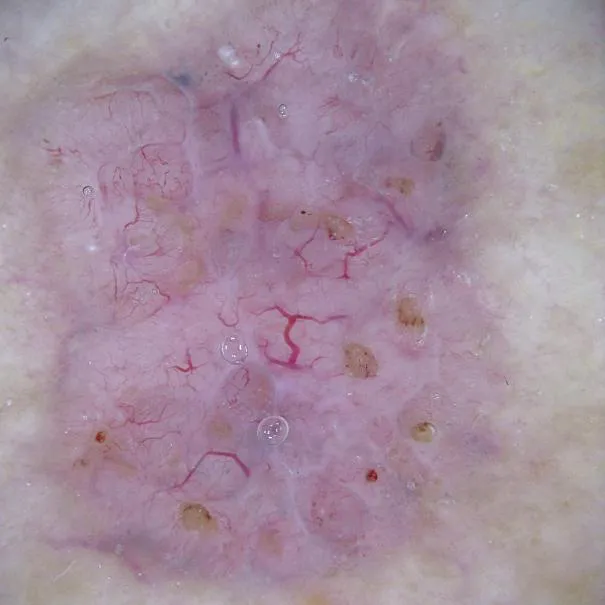
Non-polarized contact Mode

In non-polarized mode, the instrument can provide information about the superficialskin structures, such as milia-like cysts, comedo-like openings, and pigment in theepidemis.

The dermoscopy requires applying a liquid such as mineral oil or alcohol to the skin andplacing the lens in contact with the skin. This reduces surface reflection and enhancesthe view of subsurface structures.

Image with non-polarized light (DE-3100)

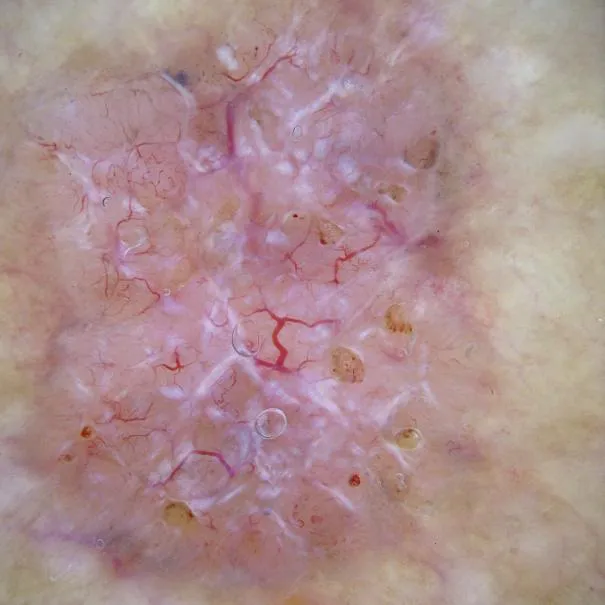
Polarized contact Mode

In polarized mode, the instrument allows for visualization for deeper skin structures,such as blood vessels, collagen, and pigment in the dermis.

The dermoscopy does not need to be in contact with the skin or use any liquid. Theirpolarized light can help to eliminate surface reflection and allow visualization ofvascular structures.

Image with polarized light (DE-3100)

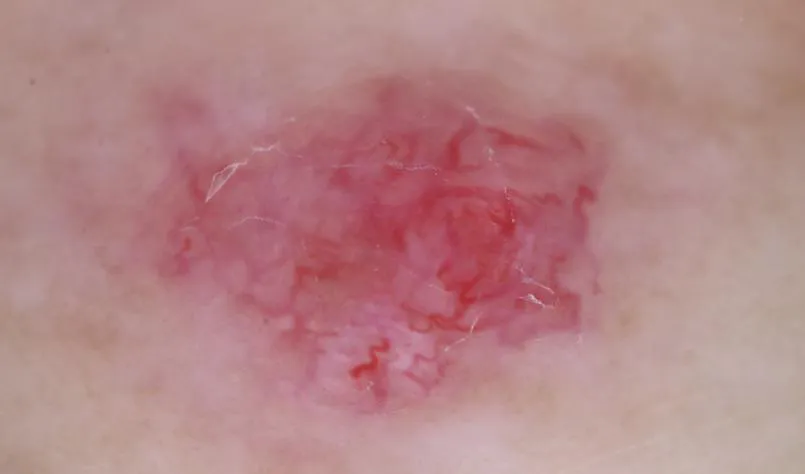
Polarized non-contact Mode

The dermoscopy can also use polarized light to examine the skin without direct contact.

In polarized non-contact mode, the instrument allows for examination infected areasand lesions that are painful for the patient, or the difficult to contact pigmented lesions,such as nails and narrow areas.

The contact plate should be removed in this mode, and it does not require applying aliquid to the skin. As it doesn’t require pressure or fluid application on the skin, it canalso avoid cross-contamination and infection risk.

Image in polarized non-contact mode (DE-3100)

How effectiveness is dermoscopy

Compared with visual inspection, the dermoscopy can be used to capture and store skin lesion photos, which play an important role in early skin cancer examination. The dermoscopy allows the

Compared with visual inspection, the dermoscopy can be used to capture and store skin lesion photos, which play an important role in early skin cancer examination.

The dermoscopy allows the examination of skin lesions with magnification and illumination. This can be greatly avoiding the factors that cause interference to visual detection. Such as lighting, skin color, hair and cosmetics.

Several studies have demonstrated that dermoscopy is useful in the identification of melanoma, when used by a trained professional.

It may improve the accuracy of clinical diagnosis by up to 35%
It may reduce the number of harmless lesions that are removed
In primary care, it may increase the referral of more worrisome lesions and reduce the referral of more trivial ones

A 2018 Cochrane meta-analysis published the accuracy of dermoscopy in the detection.

Table 1. Accuracy of dermoscopy in the detection of melanoma in adults
Detection Method Sensitivity, % Specificity, % Positive Likelihood Ratio NegativeLikelihood Ratio
Visual inspection alone (in person) 76 75 3.04 0.32
Dermoscopy with visual inspection (in person) 92 95 18 0.08
Image-based visual inspection alone (not in person) 47 42 0.81 1.3
Dermoscopy with image-based visual inspection (not in person) 81 82 4.5 0.23
ROC—receiver operating characteristic. *Estimated sensitivity calculated on the summary ROC curve at a fixed specificity of 80%.

As we can see, the dermoscope can improve the accuracy of diagnosis of skin lesions, especially melanoma.

Table 1. Accuracy of dermoscopy in the detection of melanoma in adults
Detection Method Sensitivity, % Specificity, % Positive Likelihood Ratio NegativeLikelihood Ratio
Visual inspection alone (in person) 79 77 3.4 0.27
Dermoscopy with visual inspection (in person) 93 99 93 0.07
Image-based visual inspection alone (not in person) 85 87 6.5 0.17
Dermoscopy with image-based visual inspection (not in person) 93 96 23 0.07
ROC—receiver operating characteristic. *Estimated sensitivity calculated on the summary ROC curve at a fixed specificity of 80%.

Characteristics of the dermatoscopic structure of the skin lesions include:

• Symmetry or asymmetry
• Homogeny/uniformity (sameness) or heterogeny (structural differences across the lesion)
• Distribution of pigment: brown lines, dots, clods and structureless areas
• Skin surface keratin: small white cysts, crypts, fissures
• Vascular morphology and pattern: regular or irregular
• Border of the lesion: fading, sharply cut off or radial streaks
• Presence of ulceration

There are specific dermoscopic patterns that aid in the diagnosis of the following pigmented skin lesions:

• Melanoma
• Moles (benign melanocytic naevus)
• Freckles (lentigos)
• Atypical naevi
• Blue naevi
• Seborrhoeic keratosis
• Pigmented basal cell carcinoma
• Haemangioma

We use cookies on this website to provide a better user experience. By continuing to browse the website, you are giving your consent to receive cookies on this site. For more details please read our Privacy Policy.

Hot Search Terms